










Want perfect fries? Choose the right fry cutter!
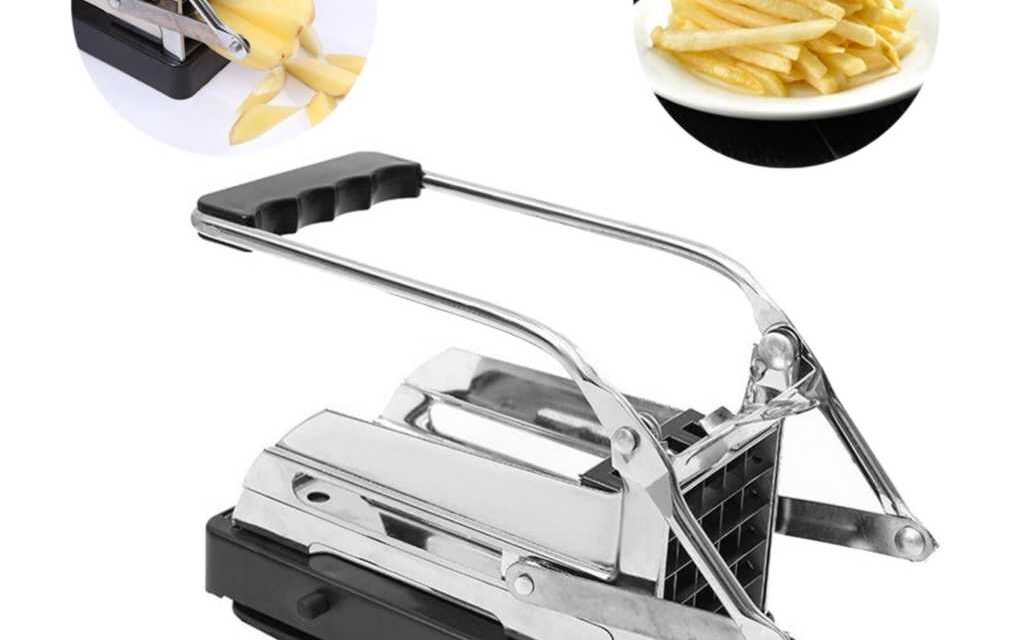
Definition of a French Fry Cutter
You simply need to know that a French fry cutter is a device used to cut potatoes into sticks to make fries.
Importance of a French Fry Cutter
Fries are a food enjoyed by both children and adults. But cutting potatoes by hand to make homemade fries can be difficult. It is hard to get hand-cut fries of uniform size, which is important to ensure that all fries cook evenly.
Additionally, cutting potatoes by hand can take quite some time. Fortunately, you can use a French fry cutter to speed up the process and ensure you get the same size fries every time. A French fry cutter is an important addition to any commercial kitchen.
It provides restaurant-style fries. Your kitchen staff will no longer have to worry about cutting piles and heaps of potatoes on top of all their other food preparation tasks.
A French fry cutter will significantly reduce the preparation time for fries. Some French fry cutters can also be used to cut other vegetables for dips and salads.
Although a French fry cutter is not a mandatory kitchen appliance for every establishment, it can be extremely useful for many. Below, we compare some of the different French fry cutters available on the market.
How to Prepare Fries?
The best method to achieve perfectly crispy fries is to fry your potatoes twice. Below, we will explain the best way to prepare potatoes for frying, how long to fry the fries, and how long you can store them before serving.
- Wash the potatoes
Optional: Peel the potatoes.
- Cut the potatoes to your preferred size
You can cut them by hand or use a French fry cutter for maximum efficiency and uniformity.
- Soak the potatoes for 3 to 24 hours in a water and vinegar mixture.
Soaking them will help remove excess starch and promote crispiness. To make the mixture, add 1 tablespoon of vinegar to a gallon of water. This vinegar will help prevent the potatoes from oxidizing and discoloring.
- Dry the potatoes
It is important to dry your potatoes to protect yourself from splattering during preparation. Use a clean towel.
Dry them on a baking sheet or place them in a salad spinner to remove excess moisture. If you store the uncovered potatoes in your cooler overnight, it will help dry them further.
- Blanch the potatoes by frying them at 325°F for 3 to 6 minutes
The time varies depending on the cut of your fries. Smaller cuts like 3/8 cm take 2-3 minutes, while larger cuts like 1/4 or 1/2 cm take 4-6 minutes. You have finished blanching the potatoes when you can bend them without breaking them.
- Cool the fries before frying them a second time
For efficiency, you can blanch multiple batches of potatoes and let them cool in your refrigerator or a cold storage room. When it is almost time to serve them, remove them from the cooler for the second frying.
- Fry them a second time at 375°F for 2-3 minutes
Since you have already blanched the potatoes for partial cooking, this second round in the fryer will make them crispy. Look for a golden-brown exterior to know they are done.
- Season the fries while the oil is still hot
The hot oil will help your seasonings stick to the fries. Use fresh herbs, salt, spices, and oil to add flavor to your fries.
- Serve your fries within 10 minutes after finishing
The ideal holding time for fries does not exceed 5 to 10 minutes. After that, the fries will lose some of their crispiness and become cold.
French Fry Cutter Buying Guide
When customers enter your restaurant and don’t know exactly what to eat, they will likely go for that good old plate of fries. Without a doubt, this type of food is one of the most popular.
Additionally, fries can be paired with almost any other type of dish. Therefore, you want your business to have a good French fry cutter. Naturally, that is not the only reason.
Since potatoes and fries are common in any kitchen, whether in a restaurant or elsewhere, you can consider French fry cutters a necessity for any food industry business.
This is the first time we are presenting our French fry cutter buying guide. Many people think cutting fries is not that simple. It is an art, and sometimes the right tools are needed. Without further ado, let’s look at what you need to consider when choosing a French fry cutter.
- Types of French Fry Cutters
Before getting into more common considerations like price and material, let’s start with two important factors: whether you need a manual or automatic cutter and whether you need a standard or heavy-duty model.
Of course, this must be decided based on the type and requirements of your business. You cannot use a manual French fry cutter when you own a fast-food restaurant and every menu item includes fries.
- Standard or Heavy-Duty French Fry Cutters
- Standard French Fry Cutter
This type of French fry cutter comes with simple and easy-to-use mechanisms that allow the operator to cut many fries in a short time. Usually made of heavy frames, they are designed to be mounted on countertops or even walls.
This ensures stability for better use. Naturally, a standard French fry cutter is not fully recommended for commercial needs. However, this depends on the number of fries you need to cut in a single day.
For example, if a dish on your menu contains fries, you can rely on a standard model. On the other hand, if your business needs to cut hundreds of potatoes each day…
- The heavy-duty fry cutter
This type of fry cutter comes with sturdier frames, but with more power and volume. Most heavy-duty fry cutters are automatic and equipped with well-designed cutting mechanisms that can handle more than a hundred potatoes per day.
Additionally, most of them are ergonomic for more comfortable use. Of course, we are talking here about heavy-duty manual fry cutters. These may save you money but may not satisfy you if you have a high demand for fries.
In terms of heavy-duty automatic fry cutters, you can choose between an electric or pneumatic model.
- Manual or automatic fry cutters
- Manual fry cutters
Regarding manual fry cutters, the operator will need to use a handle to cut the potatoes. This allows them to make specialty-cut fries, wedge fries, straight fries, etc. These are ideal for cafes and restaurants.
Even though they are manual and require an operator, they are capable of cutting potatoes into more fry types than most automatic cutters. This makes them an ideal manual product for businesses that offer a varied fry menu.
- Automatic fry cutters
As mentioned, automatic fry cutters are powered by electricity or air. Obviously, this type of fry cutter is ideal for businesses/restaurants/fast-food outlets that need to cut hundreds or even thousands of potatoes each day.
Those powered by air are equipped with cylinders that push the potatoes into the cutting blades. Electric and pneumatic fry cutters reduce the operator’s workload and make the process less tedious.
Now that we have covered the most important aspects of a fry cutter, it’s time to move on to the usual considerations. Yet, they are just as important as the aspects mentioned earlier and require your attention to determine which product is best for your business or restaurant.
So far, we have discussed the aspects you need to consider along with your business requirements. Now, we will talk about what most fry cutters should be equipped with or have as features.
- Fry cutter materials
First of all, you should keep in mind that you will be using such a product solely to cut potatoes—and you will be doing so daily. Therefore, you must choose a product made from high-quality, durable material.
Overall, the fry cutter should be capable of handling both heavy and light tasks continuously. Naturally, the materials should last a long time but should not hinder the operators.
When it comes to materials, your best choice is classic stainless steel or even cast iron, as both are very durable and can withstand daily use without wearing out easily.
- Fry cutter blades
When it comes to blades, you will probably want to check how easily they can be removed. This may sound strange, but you want to ensure that if the blades become dull and your employees notice it in the morning, you won’t have to halt production for an entire day just to replace the fry cutter blades.
Additionally, you should choose a product with sharp enough blades, as you don’t want the operator to have to sharpen them every two weeks.
These two aspects must be considered when making your purchase because you will also want to clean the blades, not just sharpen them. Different blade styles and shapes will produce different types of fries.
From straight-cut fries to wedge fries, if you aim to have open options, look for a fry cutter that offers multiple blades.
- Ease of cleaning the fry cutter
Obviously, it’s not just the blades that need occasional cleaning. The entire machine will require some dusting, so to speak, especially after a long day of cutting potatoes.
Naturally, if you’re using a heavy-duty automatic fry cutter, it’s highly unlikely that it will be dishwasher-safe. It probably wouldn’t even fit in such a machine to begin with.
Therefore, you need to ensure that the product you choose is easy to clean, as your employees will use it daily. You want it to be perfectly clean every time you inspect the kitchen.
- Types of cuts in fry cutters
As you know, different types of fries don’t just appear out of nowhere. And your regular fries can’t be magically turned into wedges in an instant. Obviously, you will also need the right sets of blades. Of course, this can be done without completely changing the machine. However, before purchasing, you must ensure that the manufacturer sells different types of blades.
Or that the blades of the unit you are buying can be modified. It is important to remember that the blades and push blocks of a certain fry cutter will not work with a different brand of cutter. Therefore, when purchasing a new blade set, make sure it comes from the same manufacturer or is compatible with your device.
If you are a restaurant owner, it is natural that you will need all the mentioned cutting options. You can’t serve 1/4-inch straight fries as a garnish or put chips on a plate instead. That’s why having the best fry cutter isn’t enough—you also need quality accessories, in this case, the blades.
- Suction cups
Manual fry cutters require some arm strength and effort. To ensure ease of operation, look for a fry cutter with suction cups or a non-slip base. This will help keep the fry cutter stable during use.
- Size and storage
The average fry cutter is usually small enough to be stored in a drawer or cabinet when not in use. Manual cutters tend to be smaller and easier to store than automatic ones since they don’t have additional electrical components.
Some high-end models may come with mounting hardware to attach the cutter to a countertop, which is ideal if you own a restaurant. However, this is not necessary for home use.
- Price
Well, you can generally pay whatever you want, but if you want a durable product that does its job without requiring adjustments or extra effort from the operator, it’s best to see it as an investment.
Obviously, a cheap imitation might get you through the week or, at best, the month. But you and your restaurant will be much better off with a branded, original fry cutter. Fry cutters can range from around 20 to 1,000 euros or more.
Manual cutters are typically made of plastic or stainless steel and vary greatly in quality and efficiency. If you’re willing to spend between 500 and 1,000 euros, there are also various automatic cutters that will do the work for you.
Final thoughts on fry-cutting equipment
We can confidently say that cutting fries isn’t as simple as it seems, and choosing a fry cutter isn’t easy either. That’s why we hope our buying guide has helped you determine which type of product is best for your business.