








Get accurate measurements with the right scale!
What is a Kitchen Scale and How to Choose One
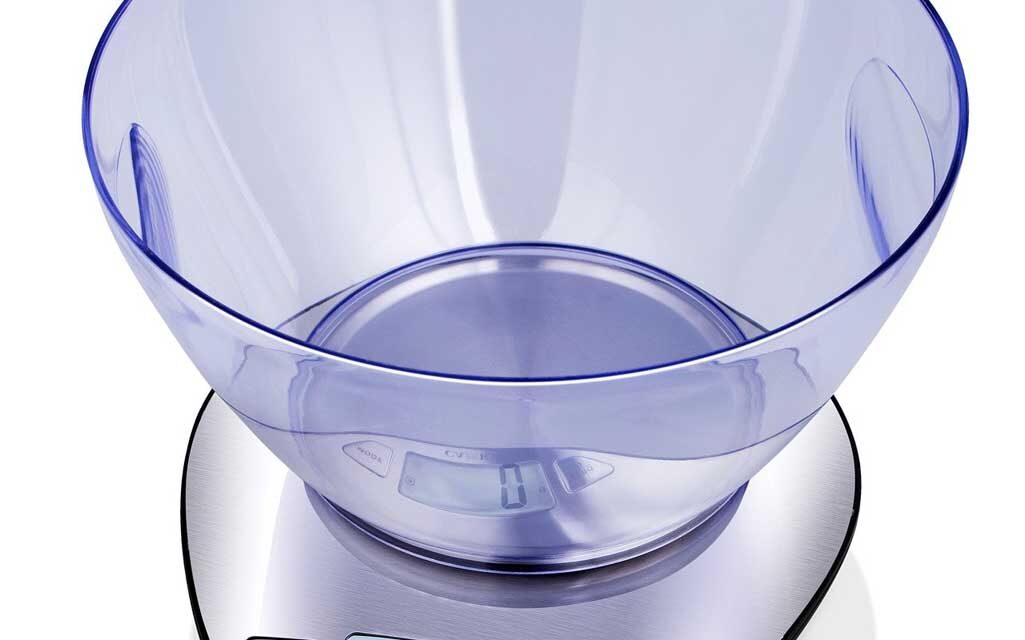
Compact in size and with a limited capacity, the kitchen scale is a cooking instrument used to precisely weigh the ingredients needed for a recipe. The gram is one of its measurement units.
The Importance of Having a Kitchen Scale at Home
It’s surprising how much different recipes can be affected by small amounts of ingredients. A kitchen scale can make all the difference in baking and food preparation.
While using good old-fashioned measuring cups works in most cooking scenarios, measuring by weight with a kitchen scale can be a game-changer in several ways. Here’s why you should definitely consider having a scale in your kitchen.
- Get More Accurate Results
We all know that baking is a science, and science requires precise measurements. Most of the time, we rely on good old measuring cups to do the job.
But measuring by volume alone can produce variable results. A cup of flour, for example, which may weigh 25 grams, can vary by a gram or more depending on how you use these traditional cups.
And if you take this inaccurate measurement and add it to a delicate recipe like chocolate soufflé, you’re more likely to get inaccurate results.
Instead of relying on measuring cups, it’s better to measure with a scale. This will give you the most accurate measurement, ensuring the best possible baking outcome.
- Manage Portions
If you’re trying to be more mindful of your diet, using a kitchen scale is the tool you need. You’ll have the ability to take precise measurements of your various foods, which can be an effective way to determine calories and other nutritional elements in your diet.
- Convert Measurements Easily
Are you worried about converting measurements correctly when trying out a new recipe? Don’t worry! Most scales convert measurements into grams and so on for you.
- Make Cleaning a Breeze
Think about the number of measuring cups and bowls you use in a lengthy recipe. Notice how many there are? Especially if you wash by hand! Using a kitchen scale eliminates the need for multiple measuring cups and spoons.
See how you can spend less time cleaning and more time enjoying the fruits of your labor. Since you’ll have at least one bowl to wash, make the experience a little more enjoyable with these tips.
- Mix Drinks
From coffee to cocktails, a scale helps you get the right proportions for your drink. Mixing complex drinks requires a steady hand, perfect pouring, and bar tools like a jigger.
Rather than estimating liquid ingredients, a scale ensures you get the exact proportions of each drink component so that it tastes perfect.
- Use Fewer Dishes
One of the most effective benefits of using a kitchen scale is that you can measure all your dry ingredients in a single bowl. Just reset the scale to 0.00 with each new ingredient and measure accordingly.
Cleanup will be faster since you won’t have to wash as many bowls, measuring cups, and spoons. Wondering where to buy a kitchen scale suitable for your needs?
From the kitchen to the market, or even to your loading dock, a kitchen scale saves time and money. Commercial scales can be grouped into four main categories, each suited to specific needs. Read this guide to help you decide which scale is best for you.
Different Types of Kitchen Scales
Wondering where to buy a kitchen scale suitable for your home or business? From the kitchen to the market, or even to your loading dock.
A kitchen scale saves time and money. Commercial scales can be grouped into four main categories, each used for specific purposes. Read this guide to help you decide which scale best meets your needs.
- Balance Scales
The balance scale is probably one of the first types of scales ever created. Although it is an old type of kitchen scale, many traditional kitchens still accept this conventional type. A balance scale measures the weight of an object by comparing it to a known pre-defined mass.
- Advantages
If you’re looking for known weights, you can easily get them separately from a market. The reason they are still so popular is that they are easy to use.
And they can help measure any type of weight quite easily. That being said, balance scales are relatively outdated because they do not provide a precise weight measurement.
- Disadvantages
One of the drawbacks of these scales is that they only indicate whether the measured ingredient is heavier or lighter than the known weights. For example, a cup of sugar is placed on one side of the balance.
Meanwhile, the known mass is placed on the other side. Mass is added until the balance is equal. However, the overall calculated mass may not be exact.
- Mechanical Scale
Mechanical scales are also known as spring scales because of how they work. Kitchen mechanical scales measure weight using springs.
When an object is placed on top of the mounted platform, force is applied to the scale. The spring compresses in the correct proportions and provides an accurate estimate.
- Advantages
These simple devices are easy to clean since they are not sensitive to water damage, unlike most digital gadgets. Some models are even dishwasher-safe.
Since they don’t require batteries, plugs, or power to function, they are more portable than electric scales.
- Disadvantages
Springs do not always provide accurate measurements. These scales can be unreliable because the compression rates may change over time or fail to return to their original length.
Or sometimes they can even break. Another drawback of mechanical scales is that they can create reading issues for small quantities compared to larger ones.
Indeed, a small quantity creates a slight movement in the spring that can be difficult to read compared to the visible movement caused by a larger object. But not all mechanical scales are inaccurate.
There are excellent quality mechanical scales that measure ingredients quite accurately. However, these mechanical scales come at a high price.
People who cannot afford such expensive kitchen scales might consider buying dry measuring cups. When used correctly, dry measuring cups can be more accurate.
- Digital Scale
This modern invention is a breath of fresh air after years of using a slightly inaccurate scale. Digital kitchen scales are undoubtedly an innovative creation commonly found in all modern kitchens.
- Advantages
A critical factor that makes a digital food scale so much better than a traditional scale is its ability to measure the precise weight of the object placed on it. This is convenient when baking since it requires precisely measured ingredients.
That’s why a digital scale is a preference for bakers. However, a good digital scale is not only one that provides highly accurate weight. It should also function properly, be easy to clean, and be simple to store.
The scale should also have a spacious weighing capacity for times when one needs to weigh a large fish or a winter melon. Therefore, it is important to look for features such as a generous weighing platform and an efficient backlit display for good visibility.
The digital display should also be large and well-lit enough to make it easy to read the measurement.
Many digital scale models have multifunctional features that make cooking and baking more convenient. For example, some models have an automatic shut-off function that remembers the last weight for 30 to 45 minutes.
So you don’t lose track if the machine turns off before you finish. Most of them also have a slim and smart profile.
Which makes them easier to store in a kitchen cabinet. A stainless steel weighing platform is always ideal. Because the best feature of stainless steel is easy cleaning without the risk of rust accumulation.
- Disadvantages
Although digital food scales may seem like the perfect option—and to some extent, they are—these scales do have some limitations. For example, digital scales are sensitive to dishwashers. If placed in a dishwasher, the scale may stop working entirely.
Additionally, they operate using batteries. In a low-battery scenario where there is no power to recharge the scale, one might face inconvenience at that moment.
- High-Capacity Scale
These scales can be mechanical or digital. What distinguishes them is that they come with a large removable bowl. Depending on the need, the bowl can be swapped for a larger or smaller size.
Since they originally come with a large bowl, they are ideally called high-capacity scales. That said, some high-capacity scales have a fixed counter. Generally, high-capacity digital kitchen scales have permanent counters.
These kitchen scales are best suited for commercial kitchens in restaurants and industries. Smaller scales can measure only up to 5 lbs. But this is not the case with high-capacity kitchen scales.
Apparently, these scales can easily measure large weights, whether it’s a big fish or several kilograms of spices. Larger items can be easily weighed.
Since they have a generous weighing platform and a visible digital display, it is easy to weigh the object. With a significant amount of space, it will also be easier to clean and handle the scale.
Before investing in high-capacity scales, it is important to assess the requirements for which the scale is needed. If large items need to be measured daily, it is best to opt for high-capacity kitchen scales. Otherwise, choose one with a removable top.
- Hanging Scale
Hanging scales are an old tool for measuring weight. Typically, these gadgets come with a hook at the bottom from which the item to be weighed is attached. When the item is attached to the hook, it pulls downward and measures the total weight with high precision.
But this is not the only type of hanging scale available. Fortunately, there is a wide variety of hanging scales on the market. For example, not all hanging scales have a bottom hook. Some of them have an empty stainless steel pan chained in, where a weighing item is placed.
Different hanging scales have different pan sizes. Typically, they come with an ideal weighing size for measuring small quantities. Please note that it is easier to measure small quantities with hanging scales.
But when it comes to hanging scales with a bottom hook, not all items can be measured. They are mainly used by fishermen to weigh large fish. Due to their portability, lifting capacity, and high precision.
Hanging scales are appreciated in various workspaces, ranging from medical laboratories to industries and outdoor tasks. Hanging scales are divided into two types: analog hanging scales and digital hanging scales.
Analog and digital hanging scales share common components such as hooks, faces, spoons, trays, and casings (aluminum, steel, plastic). Sometimes, they also have two hooks, rings, and loops. Despite these common elements, there are also apparent differences.
- Analog Hanging Scales
Analog hanging scales are portable and affordable weighing gadgets used for a wide range of applications. Ideally, they are seen in retail markets.
Where portable and handheld scales are preferred. But most people also take them to lakes to get a rough estimate of the weight of their recent catches.
Sometimes, analog hanging scales come with additional features such as different weighing modes (weigh control, display hold, piece counting, etc.) and measuring tapes.
- Digital Hanging Scales
Compared to analog hanging scales, digital hanging scales provide more precise measurements. Digital hanging scales also allow weighing in multiple units, including tons, kilograms, or a combination of them. Advanced digital hanging scales come with a remote and detachable bowl, or even better, a wireless screen for high portability.
- Top-Loading Dial Scales
As the name suggests, top-loading dial scales refer to scales where items can be stacked on top of each other and weighed together.
This type of scale is used to weigh stacks of laundry, fruits and vegetables, portions of meat, or packaged foods. Many restaurants have these scales to weigh precise food portions.
They are also used when constructing products that contain ingredients based on total weight. These scales have a number of significant features, such as a solid and sturdy construction, usually made of stainless steel.
An easy viewing angle for precise readability and temperature compensation for accurate measurements. You can find them on the market at a reasonable price.
Making them an ideal option for people with a medium budget. Top-loading dial scales also take up less space, making them perfect for limited spaces.
Below the removable bowl is the dial that provides the exact reading once the weight is placed on top. Usually, these scales come with a weight measurement of up to ¼ lb. However, the item is versatile and can be found with varying weight increments.
- The Metric System Scale
Metric system scales come with basic but essential weight units, including grams, liters, and meters. This means that with the help of these units, both liquid and non-liquid ingredients can be weighed.
This is why they are essential equipment for cooking and baking. By investing in good-quality kitchen scales and using them for measurement purposes, the user will instantly experience greater ease and convenience.
- Mechanical Scale – Why You Should Ditch Your Measuring Cups for a Digital Scale
For more precise results, swap your measuring cups for a digital scale. It is the most reliable and accurate way to ensure your measurements match your needs exactly. Digital scales accurately measure both wet and dry ingredients.
While liquid ingredients measure at a constant volume no matter what, dry ingredients do not. Because they have a certain compressibility, which means their volume can change depending on factors.
Such as how compact they are inside the measuring cup or even the humidity of the area. Thus, a digital scale ensures an accurate reading for both types of ingredients, without worrying about dry measuring cups and liquid measuring cups.
How Should You Use a Digital Scale?
A digital scale is a measuring device that reads and displays the weight of an object. Compared to an analog scale, a digital scale is a high-quality scale that provides a more accurate weight reading. A chef uses a digital kitchen scale,
also called a gram digital scale, to measure the weight or mass of an ingredient, expressed in grams. Typically, digital kitchen scales are small, lightweight, and take up very little space on a kitchen countertop.
Some scales, such as pocket digital scales, are small enough to be used on the go. With a digital kitchen scale, you can quickly and accurately add your ingredients to your mixing bowl without dirtying extra cups and dishes.
Better yet, you can easily double and triple recipes and get reproducible results every time. Don’t be intimidated by using a kitchen scale for cooking. It’s so easy to do and saves you from wasting ingredients, losing time, and feeling frustrated!
- Using a Digital Kitchen Scale
- Turn on the scale using the power button.
- Set your scale to the measurement unit your recipe calls for using the “mode” or “unit” button. Press the button until the display shows the correct measurement.
- Place your chosen container, such as a mixing bowl, on top of the scale. You will see the scale register and display the bowl’s weight. Press the “zero” or “tare” button to remove the weight of the bowl and reset the display to zero.
- Add your first ingredient according to the recipe instructions. Once your display shows the correct amount, stop. If you add too much, remove a little. It’s that easy.
- Press the “tare” button again to reset the weight of the ingredients you just added.
- Start adding the next ingredient based on the recipe until the display shows the amount you need.
That’s it! A super simple way to add ingredients with supreme accuracy and without worrying about making mistakes in your recipe.
It may feel a bit strange the first time you do this. But, know that it will become easier over time. And soon, you’ll wonder how you ever managed using measuring cups!
5 Tips for Calibrating a Digital Scale
It’s important to regularly calibrate your digital scale to ensure accurate readings and precise measurements. Keep these calibration process tips in mind:
- Calibrate on a Flat and Level Surface
This will result in a more accurate reading.
- Use a Grip Pad
This will help absorb vibrations that could disrupt your reading. A mouse pad also works.
- Check the Owner’s Manual
Refer to the owner’s manual for detailed instructions on how to calibrate your specific brand and model.
- Use Calibration Weights
You can also place test calibration weights or another object with a known weight on the scale to ensure it is properly calibrated.
- Calibrate Regularly
How often you should calibrate your digital scale depends on how frequently you use it. Generally, a good rule of thumb is to calibrate it before you start using it for a recipe. The recommended calibration frequency may vary by model.
6 Things to Know Before Buying Your Kitchen Scale
Designed to weigh food ingredients accurately and precisely, so you can avoid guesswork, kitchen scales are an essential kitchen tool.
Use them to measure the desired amount of food according to dietary requirements or simply to measure various ingredients more accurately for your cooking and baking. Widely used, many recipes include ingredients measured by weight.
Cooks worldwide find kitchen scales a useful addition to their kitchen. Before purchasing a scale for your kitchen, consider the following six tips to choose the best model for your needs.
- Analog or Digital
There are two types of kitchen scales to choose from. Analog or mechanical scales consist of an internal spring that indicates the weight with a rotating pin.
Electronic or digital scales run on batteries and display the weight on a digital screen. They also tend to offer various additional features.
Notably, some models can store data. Most modern kitchen scales are digital models. The digital display shows a decimal value, which is usually accurate to a tenth of a unit.
- Capacity and Sensitivity
Consider the foods you will likely be weighing to determine the capacity you need in a kitchen scale. Some particularly sensitive scales are ideal for weighing small amounts of food.
Including lightweight items such as herbs, spices, and nuts. Other scales are suitable for weighing heavier items like large cuts of meat and whole poultry.
- Enhanced Digital Features
Digital scales have a wide variety of features that may be useful to you, depending on your goals. These benefits include the ability to switch between different units of measurement. Including grams, kilograms, and more.
Another useful feature is a tare function, which allows the scale to account for the weight of the container and display only the weight of the contents. Some models also feature a timer and a baker’s clock.
There are even scales programmed with calorie readings for various foods. These models allow you to add your own recipes and food entries. Some also have a memory function that tracks your calorie intake.
- Platform and Container
Platform sizes vary. It is often a good idea to get a scale with a generously sized platform so that you have enough space to weigh a variety of foods.
Also, choose a scale that comes with a container for weighing food, including dry and wet ingredients. Make sure it is removable for easy cleaning. Some models include a measuring bowl, allowing you to measure ingredients easily.
- Ease of Reading
Not all digital displays are created equal. Some are small and difficult to read. Test each model if possible and opt for a large digital screen.
Also, look for displays that do not get hidden when covering the scale with items to be weighed. Some scales have a retractable display, making reading the weight much easier.
- Design and Ease of Storage
If you store the scale on your kitchen counter, it is important to choose a model that fits well and enhances the look of your kitchen. There are many different styles available.
Many are made of stainless steel, adding a sleek appearance to your kitchen. Now that you are familiar with these types of kitchen scales.
And all the differences between them, you can purchase a model that enhances your cooking experience and helps meet your dietary needs.
Daily and Deep Cleaning of Your Kitchen Scale
Things to Do:
- Use a small brush to gently sweep away any residue from the scale.
- Moisten a thin wipe with purified water and thoroughly clean the pan and around the scales. Wipe dry.
- Remove the pan for easier deep cleaning.
- If you have moved your scale and it has a leveling bubble, check that it is centered.
- Pressing down on the scale plate can damage the internal mechanism, especially for scales that measure very small weights. Be gentle!
- Turn the scale upside down and shake it to help remove any residues. Do not be rough.
- Do not drop the scale or place it roughly on a surface. Imagine the scale as a sleeping baby: move it only if necessary and handle it with all the gentle care you can muster.
- Do not use aggressive cleaning liquids like ethanol, as it reacts with agar, salts, and other common ingredients.
- Do not leave salts on the scales. This can corrode the scales, leading to poorer performance.
- Checking Accuracy: Why It Matters and How to Verify
- Ensure your scales are completely free of residue before proceeding to check the scale’s accuracy.
Accuracy is the reliability of the scale in measuring the weight of a sample. This can be determined by several tests, each designed to help ensure that your scales operate at maximum efficiency.
- The Repeatability Test
- The Pan Position Error Test
- The Linearity Test
Your scale should also be left on for at least one hour, and ideally overnight, before use.