










Buying guide: which spatula or scraper should you choose?
What is a spatula?
If you ask people whether they have a spatula in their kitchen, most will quickly answer yes. But really, what is a spatula? Are you sure you have one at home?
A spatula is a very important tool in the kitchen, whether at home or in commercial food establishments. Some people may not immediately realize its importance, but it is a handy tool that can solve many cooking problems.
A spatula is sometimes also called a palette knife. Unlike other types of knives, this one does not have a sharp edge or blade because it is not designed for cutting or chopping. It is flat, flexible, and wide, with a perfectly rounded edge so that it cannot poke or scratch.
The importance of the spatula
One of the most important tools in a cook’s kitchen is the spatula. These humble tools can make cooking more comfortable and faster. Fortunately, there are many of these tools available on the market today.
However, it can still be challenging to choose the right one among the myriad of choices available. To help you select the best spatula, here is a guide for you. This guide contains the essential elements to consider before choosing a spatula.
What materials are used to make spatulas?
- Metal
The main reason some people get confused when identifying a spatula is that there is a wide variety of materials used to make this kitchen tool. Metal spatulas are the most traditional.
These are still recommended today because they are highly durable. Those made from a thin sheet of metal are flexible but not fragile, making them easy to use. Metal spatulas also have heat-resistant handles.
- Wood
Another traditional material for spatulas is wood. Many people prefer this material because it does not require much effort to lift and does not conduct heat.
- Plastic
Plastic spatulas are also available today. These are excellent because they are lightweight. However, they are not recommended for high-temperature cooking. Sometimes, plastic spatulas tend to melt if used to stir hot food.
- Silicone and Rubber
Nowadays, silicone and rubber spatulas are becoming increasingly popular. These are specifically designed not to scratch pots and pans.
Especially those with a non-stick or Teflon surface. Silicone and rubber spatulas are also excellent because the material will not melt, even if it touches an extremely hot surface.
Why is the rubber spatula everyone’s favorite kitchen tool?
A rubber spatula, or scraper, as it is sometimes called, is different from the spatulas you use to flip fried eggs and pancakes. Instead, it functions more like a spoon or spreader. But you will use it much more than you think.
Chefs love it because it allows you to scrape every ounce of substance from a mixing bowl or container, ensuring nothing goes to waste. Honestly, there is nothing better for getting every last bit of brownie batter from the bowl into the pan.
And rubber spatulas come in many different widths, allowing you to stir and mix, evenly distribute your ingredients, and, of course, scrape. The big problem with some rubber or silicone spatulas is that they can be fragile and fall apart.
Design and use of the spatula
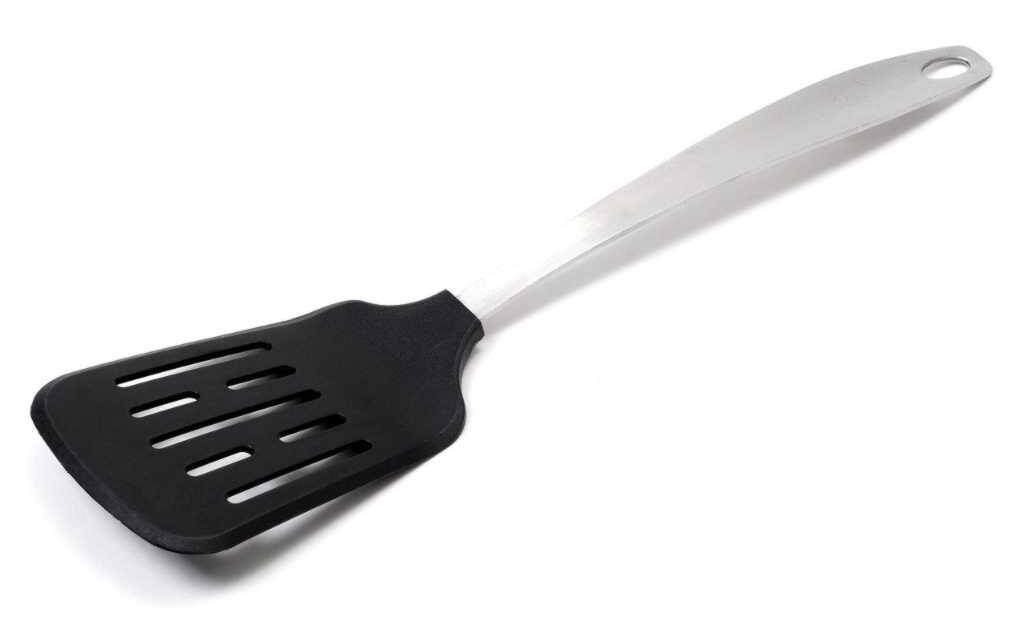
The shapes of spatulas vary depending on their use. Some are square or rectangular, while others are elongated. Usually, spatulas are also perforated, especially those used for cooking.
This way, other wet ingredients or oil won’t stick to the surface. Spatulas with holes are ideal for frying. Spatulas without holes are often used for mixing and folding ingredients.
They are more efficient, making them perfect for baking since ingredients blend more easily. When applying frosting to a cake, it is also ideal to use a spatula without holes.
The different types of spatulas and how to choose the right one?
Everything about the different types of spatulas, with advantages and disadvantages for each material, to help you choose and buy the right type of spatula for cooking each meal. Spatulas fall into three main categories:
- Flippers
- Spreaders
- Scrapers
Each has a specific purpose and is available in a variety of options and features. Choosing the right one for the job is half the battle. Deciding which model you prefer is the other half.
- Flipper Spatulas
- What does it look like?
This spatula consists of a long handle and a wide, thin surface, usually trapezoidal in shape. (For those who slept through geometry class, that’s a trapezoid.) It can be solid or slotted, and the “blade” is about the size of a human hand. The tip is often tapered to help slide under food.
- What is it made of?
Many flipper spatulas are made of metal, such as steel or aluminum, which is strong, durable, and easy to clean. Other materials include plastic, nylon, or silicone, which are gentle on your cookware and do not leave scratches while being heat-resistant.
But be careful not to leave them in the pan, or you might end up serving a melted spatula (gross!). Finally, you can opt for a wooden or bamboo spatula. Some people swear by these traditional tools.
Since wood is heat-resistant, affordable for cookware, and suitable for acidic foods, it never leaches chemicals or strange odors into your food.
Just make sure to wash them immediately and never leave them in water (they tend to split if left wet too long). We love this one that doubles as a spoon or the one that serves as a spoon rest.
- What is it best for?
Flipper spatulas are used to flip or turn foods like grilled cheese, fried eggs, burgers, and chopped vegetables. Every seasoned grill master has a favorite grill spatula in their arsenal.
Certaines sont plus épaisses ou plus minces, plus ou moins flexibles. Elles peuvent avoir une poignée souple ou extra-longue. Ou même un bord dentelé pour une coupe pratique dans le moule. Chacune est destinée à un objectif très spécifique. Mais elles peuvent toutes être utilisées à la place d’une autre.
- What options can you find on the market?
- Perforated spatulas
Perforated spatulas have a bunch of small holes that allow excess grease and oil to drain away. They are best suited for flipping greasy burgers.
Barbecue spatulas are an example of the perforated type. They are extra long, very sturdy, and made from quality metals capable of withstanding intense heat and extra weight. They even come in customizable designs.
- Slotted spatulas
Slotted spatulas have long slots that are perfect for handling delicate foods like crepes and pancakes. We’re not sure how they manage to keep these crumbly and fragile foods intact, but they do!
- Fish spatulas
Fish spatulas are a very specific type of slotted spatula with extra-long slots and a thin, slightly curved surface that helps you turn flaky fish like a pro.
- Solid surface spatulas
Solid surface spatulas are often the most flexible in the group. They are perfect for flipping soft foods like pancakes and French toast.
- Which one should you choose?
You probably don’t need that many fin spatulas in your home. So if you want to choose just one, we recommend looking for a sturdy, medium-sized slotted spatula with a soft handle.
- Spreader spatulas
- What do they look like?
Long and narrow, these spatulas resemble their namesake ancestors (swords). Too dull to be useful in a duel, their flexible blade and rounded tip make them a formidable weapon for culinary battles.
- What are they made of?
Most spreader-type spatulas are made of metal, such as stainless steel, although many models are also available in plastic and rubber.
- What do they do best?
As you may know, they are best used for spreading soft toppings like cake frosting, cheese spreads, and sandwich condiments. The rounded tip is ideal for scooping the perfect amount of creamy topping, and the flexible blade makes it easy to spread toppings without tearing the bread or cake base. Every baker or bagel spread enthusiast should have one in their drawer.
- What options can you find on the market?
There are two main types:
- Straight
- Offset
Offset spreaders have a bend in the handle’s neck, allowing you to cover a large flat surface without getting your hand in the product. (Imagine trying to frost a sheet cake with a flat blade—things could get messy quickly!)
Rubber models are very flexible and suitable for soft and fluffy frostings like buttercream. Straight spreaders are usually shorter and rounder.
You often find them in delis, and they make excellent cheese spreaders. They are also great for getting frosting on the shorter, rounded sides of cakes.
Which one should you choose?
This is an important question. Many professional bakers swear by their offset spatula to apply smooth, flawless layers of sweet frosting without getting their hands dirty.
On the other hand, bagel lovers should opt for a straight model, which makes quick and easy work of deli-style spreads.
- Scraper spatulas
- What do they look like?
Hard to describe but easy to recognize, rubber-tipped spatulas have a rectangular head with at least one rounded edge at the end of a straight handle.
They come in various widths and lengths and can be found in a rainbow of bright colors, making them look more fun than other, duller utensils.
- What are they made of?
Silicone models are also a popular choice since they offer some heat resistance, allowing them to be used for hot ingredients.
Slim handles are super simple and can be made of various materials like wood, rubber, or plastic.
- What do they do best?
You wouldn’t want to use a rubber spatula on the stove because it might melt (burnt rubber isn’t appetizing at all—ask me how I know!). It’s best for mixing, folding, and scraping cold and wet ingredients in a mixing bowl.
No tool cleans sticky dough off a flat surface better. It’s like a squeegee for bakers. Anyone working with dough should have a few on hand.
You always want to have at least two so you can use one to scrape the other. They are easily available on the market at low prices, so go ahead and buy a few.
- What options can you find on the market?
Rubber spatulas are quite basic, so the options mostly concern size and color. Silicone versions serve both hot and cold uses.
However, they often lack the strength needed to be truly useful for stovetop cooking. Wooden spatulas also fall into this category. They are often used for mixing salads or stirring tomato sauces.
- Which one should you choose?
Silicone and rubber each have their pros and cons. If you want more heat resistance, choose a silicone spatula. If you’re only using it for cold ingredients, go ahead and grab a rubber spatula. Another difference:
Rubber stains more quickly, but silicone easily absorbs strong odors and won’t let them go without some effort on your part. Be sure to choose one with a handle that meets your needs. Wood is heat-resistant.
But it tends to crack over time. While plastic is easy to clean. But it may melt if exposed to high heat. Most people have a few spatulas in their collection. Which makes it easier to choose the right one each time.
Spatula Materials: Pros and Cons
Now that you know when to use each type of spatula, here is a handy list of the most notable pros and cons of the materials used to make them:
- Rubber
- Pros
- Soft and flexible, does not scratch pans
- Inexpensive and available in a variety of stores
- Cons
- Not heat-resistant
- Stains easily
- Silicone
- Pros
- Non-stick and easy to clean
- Gentle on pans
- Cons
- Retains cooking odors
- Prone to cuts from sharp blades
- Metal
- Pros
- Durable and long-lasting
- Can handle heavy foods and tough jobs
- Cons
- More expensive
- Easily transfers heat
- Wood or Bamboo
- Pros
- Eco-friendly and non-toxic
- Long-lasting
- Cons
- Requires regular care
- Porous material can harbor bacteria or food particles (do not use with raw meat)
- Plastic
- Pros
- Inexpensive
- Easy to clean
- Cons
- May leach chemicals
- Shorter lifespan
How much should I spend on a spatula?
Unless you’re looking for the highest-quality brands, you should be able to find a variety of spatulas that suit your needs and budget.
Although prices may vary, most stores offer spatulas at prices that won’t break the bank. Make sure to check that the spatula you buy has the features.
That you want (heat-resistant, easy to clean, etc.). Buying a second product because you didn’t get it right the first time will cost you more money in the long run.
How do I clean my spatulas?
Always follow the manufacturer’s instructions for cleaning and maintaining your spatulas. Most modern models are dishwasher-safe. But it’s always wise to check the packaging when purchasing.
It is worth noting that some materials require more care than others. Wood and bamboo have many advantages. However, they require special maintenance. Here are some tips for maintaining your wooden or bamboo spatulas:
- Do not wash them in the dishwasher and never leave them soaking in water
- Let them dry completely before storing
- Clean them immediately, do not let food dry on their surface
- If they smell or have stains, use a mixture of baking soda and mild dish soap
- Oil them once a month with food-grade mineral oil
- Hydrogen peroxide can be used to disinfect them
Are there eco-friendly spatulas?
The best option for someone looking for an eco-friendly spatula is a wooden or bamboo model. Look for a brand that promotes sustainable logging, responsible farming, an organic manufacturing process, and recyclable packaging for the smallest footprint.
How do I know when it’s time to replace my spatulas?
Unless you choose a high-quality solid stainless steel product, you will likely need to replace your spatulas. Watch out for cracked or loose handles.
Brittle rubber, split wood, bad odors, and warped surfaces. All these things will negatively impact performance and can make the spatula prone to harboring bacteria or mold.
You may also choose to buy new spatulas due to excessive staining. Purchasing bright or dark colors should reduce stain visibility. And you may also consider matching colored spatulas.
With foods of the same color (red for tomato sauce, white for cream cheese dips, green for pesto, etc.). Fortunately, spatulas are generally affordable and easy to find. So replacing your worn-out products should be quite reasonable.
Conclusion
It’s not a bad idea to have several types of spatulas in your kitchen. After all, different models have different uses. When choosing the right one, you should think about how you plan to use it.
Is it for cooking, baking, or flipping pancakes? Consider the type of bowls, pots, and pans you have too, as some require a specific type of mixing tool so they are not damaged. If you opt for those with angled tips and are left-handed, it’s best to check if the angle works for you as well.
How to choose your spatula?
It is important for you to consider several criteria when choosing one or more spatulas for your kitchen. Here are some criteria that we think are very important:
- Materials
Spatulas are made from different types of materials, each with certain advantages over others. The most common materials for spatulas are:
- Stainless steel
- Plastic
- Silicone
- Wood
By considering the pros and cons of these different materials listed above, you can make your choice.
- Spatula edges
It can be frustrating to try flipping or lifting your perfectly fried eggs only for them to crumble or tear. The leading edge of the spatula will affect how effectively you flip your food. If you cook delicate dishes.
For example, pancakes. You should opt for a sharp, thin leading edge. Based on our research, metal spatulas generally have the sharpest and thinnest edges.
Make sure the spatula should not damage your pan or sauté pot. If, on the other hand, you are cooking heavy foods, a thicker edge on your spatula might be exactly what you need.
- Handle length
If you want to control your food while cooking, you should consider the length of the spatula’s handle. Shorter handles can bring your hands closer to the heat, but there is no denying the greater control they provide. They are simple and effective. If you are less concerned about control and want to cook comfortably and away from the heat, long-handled spatulas are a great option.
Therefore, these types of spatulas are perfect for high-temperature cooking. Additionally, if your spatula has a wide head (more on that shortly), longer handles can actually give you a greater degree of control.
- Head width
Your spatula comes with different head widths. For people who want better control over stirring and moving food, a wider head will improve the cooking experience.
A medium-width head is great for foods that need to be cut into small portions. For example, cakes—a smaller head width will be an excellent option.
- Flexibility
Flexibility is great. However, it becomes a problem when the spatula is too flexible. If the spatula bends alarmingly even with a small amount of force applied, get ready for a frustrating cooking experience.
Therefore, before making a purchase, test the flexibility. You should also consider the effect of applied heat on the spatula’s flexibility.
- Ease of cleaning
For most people, the best spatulas are those that are dishwasher-safe. Whether it is dishwasher-safe or not, your spatula should not be difficult to clean after use. An easy-to-clean spatula makes life easier and even ensures a “healthier” spatula.
- Price
Spatulas come in a wide range of prices. Therefore, choose a spatula that performs well within your budget.
The Maryse
An introduction to the Maryse
Cooking and baking require a set of Maryses to ensure successful preparations. This type of spatula has a handle (made of wood, stainless steel, silicone, etc.) that is longer than the soft silicone “blades.” In practice, Maryses are very useful.
They are used to incorporate ingredients, mix sauces, etc. They preserve delicate ingredients such as chocolate mousse and whipped egg whites. Maryses are also used to spread creams, icings, and sauces.
Easy to maintain and available in multiple colors, the Maryse has the advantage of adapting to all types of preparations. It is essential to choose your spatulas well, regardless of the reason for purchasing them. High-quality spatulas will be useful for many years and will also be well-suited for culinary uses.
Quality wood will not splinter, premium steel will not rust after the first use, and good silicone will not deform.
Choosing the right Maryse for your kitchen
There are a few elements to consider, and its cost ranges between 5 and 20 euros. So, there is little risk of making a mistake when choosing the right Maryse.
- Materials
The heads of Maryses are usually made of food-grade silicone. The handle can be made of wood or plastic.
- Health
Check the quality of the silicone. Choose BPA-free silicone or other materials that are safe for health.
- Hanging hole
A simple but practical detail—a hole in the handle allows you to hang the Maryse, which can be useful in certain kitchens.
- Operating temperature
Depending on the quality of the silicone, there is some temperature variation. The wider the temperature range, the better the quality of your spatula. Ideally, it should withstand over 240°C.
- Warranty
The warranty period is often longer for quality products. For a cheap product, it is usually one year. If your spatula breaks or cracks, you will need to buy a new one after the warranty period.
- Maryse sets
Sold in sets, Maryses are cheaper and can be used for multiple purposes. The price range is not too significant, allowing you to get extra accessories.
The Dough Scraper
What is a dough scraper?
Mainly used in baking and pastry making, the dough scraper, which has a semi-flexible half-moon shape, is generally made of plastic. However, you can find stainless steel and silicone versions on the market.
It typically measures between 15 and 20 cm in diameter. It is used for scraping bowls and cutting dough portions. Primarily used in French pastry making, the dough scraper can be both rigid and flexible.
Why use a dough scraper in baking?
It is true that you can use a spatula while baking. However, using a dough scraper is even more practical. It is more rigid than a spatula.
Due to its design, the kitchen scraper is quite firm, allowing you to easily scoop up chocolate ganache without requiring excessive movement.
It adapts easily to all types of mixing bowls. It can also be used to scrape mixture residues. Since it is inexpensive, you can have several scrapers in your kitchen. You can even make your own scraper by simply using a flexible bucket lid.
Are there different types of dough scrapers?
Depending on their shape and size, there are several types of kitchen scrapers available on the market. This utensil is more commonly used in pastry making, unlike the Maryse, which is more frequently used in cooking.
With a dough scraper, you can prepare various pastry items, such as:
- Chopped hazelnuts
- Shiny decorations
- Caramel
- Lemon cream
- Mixtures
- Chopped pistachios
- Custard
- Etc.
So, do not hesitate to equip yourself with these different kitchen utensils—the spatula, the dough scraper, and the Maryse—which will allow you to prepare delicious meals for your family.